
Untraceable Turns
On the mystery that emerges in the making

Some mornings I arrive in the studio with a very clear idea of what I’m going to do. I have a goal in mind - a colour palette, a mood and a direction. As I become more involved in the process, one decision leads to another decision and then another. I adjust something and it changes the entire surface. I respond to that change instinctively. Hours can pass like this - responding, correcting, covering, uncovering. If time allows, I’ll keep working, until I reach a point where the painting feels somehow resolved, balanced in a way I couldn’t have dreamt up beforehand.
There’s something quietly wonderful in that realisation. That it has come together in its own organic way, without pressure and without me having to push it into place. And yet when I revisit that same painting later - the sequence of it, the small turns, the risks that somehow held, the moments where I almost went too far - can feel unreachable. If someone asked me to repeat it exactly, I couldn’t. It feels like discovering evidence of a version of myself that only appears when I’m fully inside the work and a part of me that moves without commentary.
There’s a quote by Helen Frankenthaler that I’ve always loved:
“If you always stick to style, manners, and what will work, and you’re never caught off guard, then some beautiful experiences never happen.”
I come back to it often. Because that being “caught off guard'“, that slight loss of certainty, is usually where the painting becomes itself.
That isn’t to say it’s easy. By the end of the day I’m physically and mentally tired, but it’s a good, satisfied tired. The kind that comes after sustained attention and staying with something longer than was comfortable. And this discomfort can come and go, and come back again, as the painting is almost navigating itself in its own time. There’s a strong sense of release too. As if something has moved through me and settled on the canvas instead of staying inside. Not intense emotion, just whatever I was carrying that day, worked out in colour and feeling.
I don’t tend to keep unfinished canvases around. If something feels unresolved, I stay with it or pause and come back to it. This isn’t because I’m certain I can fix it, but because I’ve learned that the point where I feel most unsure is often the threshold of something unexpected happening. The painting that looks irretrievable at three o’clock can feel inevitable by six.
Recently, I found myself standing in front of “Hours were the Birds”, a painting from my most recent collection. I remember how hard it was to make and how many times I thought I’d pushed it too far, shifting repeatedly between almost working and completely falling apart.
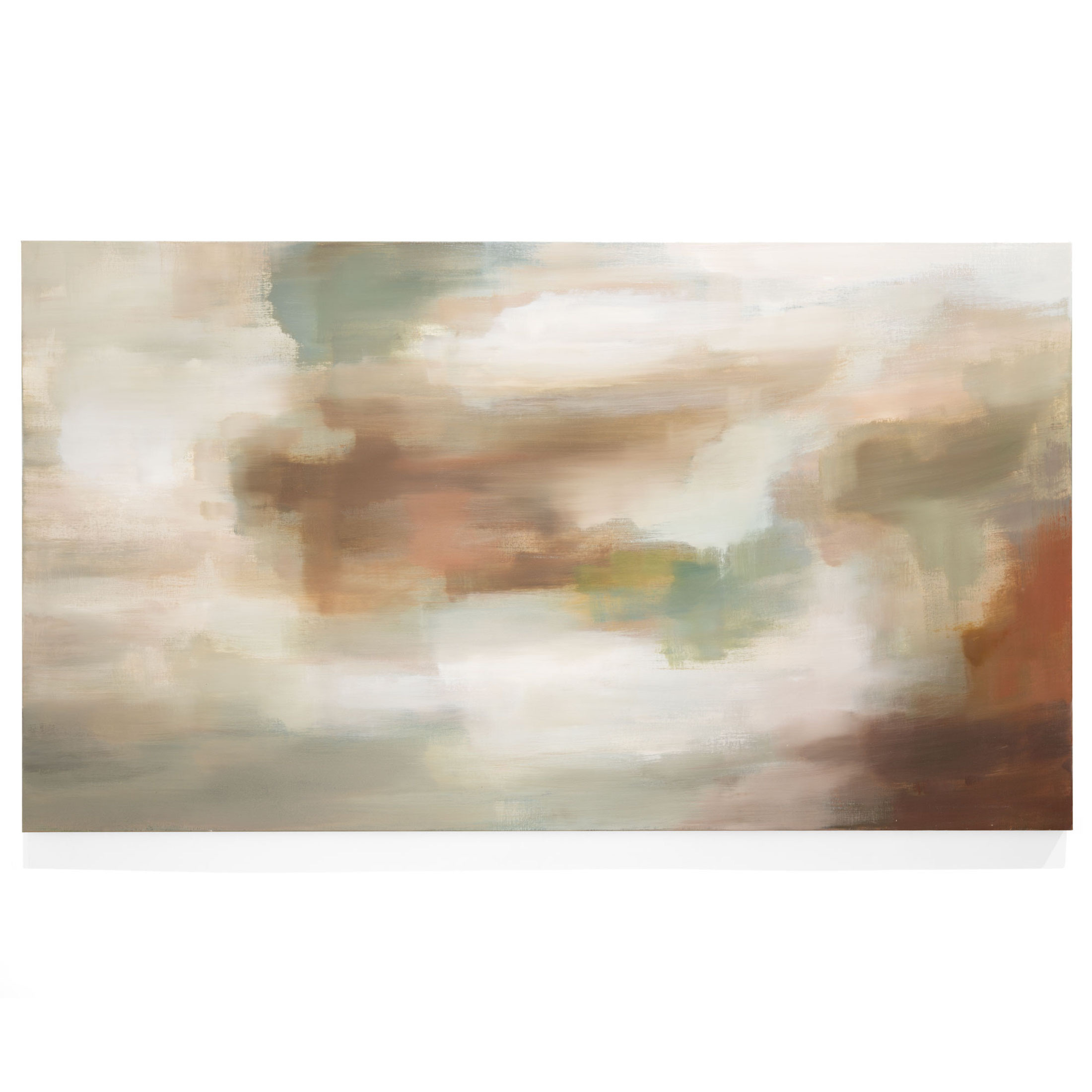
And yet what remains on the surface now carries none of that hesitation, leaving the painting feeling more resolved in a way I could have never planned. That’s the part that resists explanation - you can resolve a painting through skill, but something else moves through it as well, something you can’t plan or rehearse.
The work becomes what it becomes through a series of tiny, untraceable turns and detours. And the longer I paint, the more I feel that this is the real work: not controlling the outcome, but making space for surprise and uncertainty.